Installation
A new door is a measuring job before it is a shopping job.
Width and height are the easy part. Headroom, backroom and the way the opening is framed decide which doors will actually fit and which ones will not.
Chapter 01
Measuring the opening
Four numbers decide the job. The width and height of the opening, the headroom between the top of the opening and the ceiling, and the backroom from the opening to the back wall. Headroom is the one that catches people out, because a standard torsion setup wants around twelve inches and plenty of older garages on the plateau do not have it.
Where headroom is tight there are answers: a low headroom track kit, or a jackshaft opener mounted on the wall beside the shaft rather than a motor hanging from the ceiling. Both are ordinary solutions, but they have to be decided before the door is ordered rather than discovered on fitting day.
We also look at how the opening is framed and whether the existing jambs are sound. Rot in the timber around an opening is common in this climate and it is much easier to deal with while the old door is out.
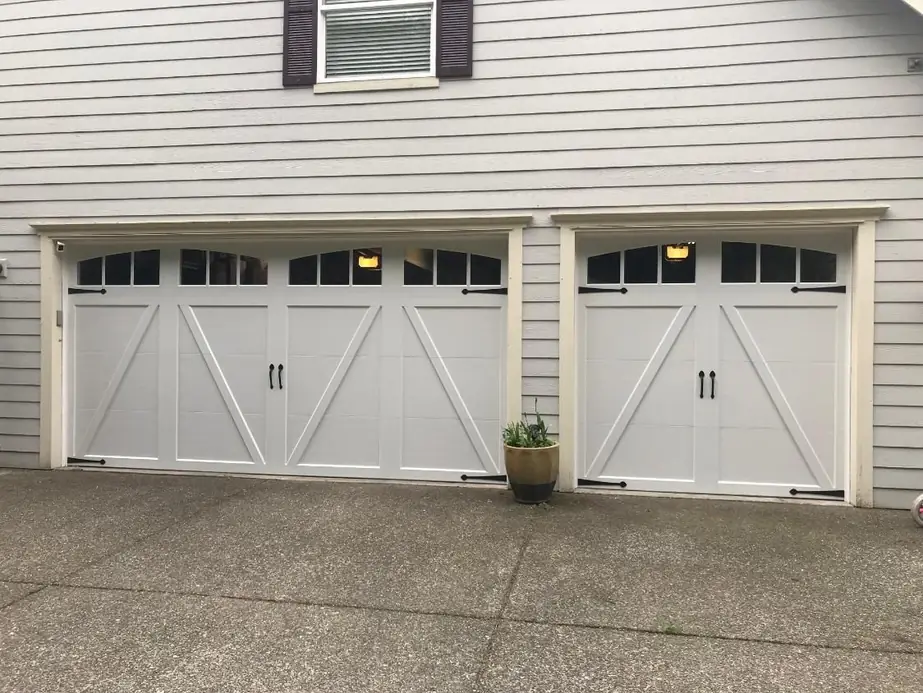
White carriage house style double garage doors installed on a Pacific Northwest home
Choosing a door for this weather
We install aluminium, carriage house, composite, decorative, insulated steel, overhead, roll up, sectional and swing doors. For an attached garage on the plateau, insulated steel is the workhorse: it holds up to wet winters, it does not take on water the way an untreated timber door can, and the insulation matters if there is a room over the garage.
Composite and carriage house styles are the usual choice where the look of the house is doing some work, and they can be specified in a colour and panel style to match. A wood door is still the right answer for some houses, but it wants to be a decision made with the maintenance in mind rather than on the showroom photograph.
Doors we install include Amarr, Hormann, Wayne Dalton and Clopay. We fit and service these products, we are not the manufacturer.
Chapter 03
What install day looks like
The old door and its hardware come out and go away with us. The new sections go up from the bottom, the track is set and squared, the spring is sized to the finished weight of the door and wound to the correct turns, and the opener is set and its safety sensors aligned and tested.
Before we leave, the door gets balanced by hand with the opener disconnected. A correctly balanced door will hold its position halfway up on its own. If it drops or climbs, the spring is wrong, and that is the difference between a door that lasts and one that eats an opener.
You get a one year warranty on the labour and the manufacturer warranty on the door itself.
Free estimates on every installation, and we will meet a competitor's price if ours does not already beat it.